
An instrument of Anan Éternel · Stage 1: Reserves
You are paid on the 25th. By the 26th, every pound has a claimant, and your reserves are not one of them.
The First Charge is a written instrument that ranks every claim on your income and puts your reserves second, straight after your essentials, paid by standing order on payday. Decided once, in writing, before anyone can ask.

The film is in preparation.
£120, paid once. Two sittings, about three hours in all with the preparation. Then five minutes a month.
Not ready to buy? See your own payday queue, free.
An ordinary month
- Payday comes, and by evening most of it is already promised.
- A family name appears on the phone, and the sums begin before the call is answered.
- The boiler fails, or a letter comes home from school, and the cost goes on a card because there is nowhere else for it to go.
- In a good month something is left over, and by the next it has quietly gone.
- The banking app waits unopened for the right moment, which rarely comes.
- A small thing bought for oneself carries a quiet guilt, as though it were taken from someone else.
- Salary may have grown over the years. What remains at the end of the month has not.
None of this comes from carelessness. Every claim is met faithfully, as it arrives, because no one ever wrote down the order in which they should be met.
It is not discipline that is missing.
It is the order.
The finding
Most of what leaves your account was never decided by anyone.
The first sitting sets every claim on your income down in one place, the Register, and asks one question of each: was this amount ever agreed, or did it simply begin? Few women have ever seen the answer written down.
44 per cent of everything Naomi pays each month was never decided by anyone, herself included.
“I earn 4,000, all but 50 of it is spoken for before I see it, and nearly half of that was never decided.”
Naomi's Finding Line, written at the close of her first sitting. Naomi is the worked case that comes with the instrument. She is not a real person, but her position is an ordinary one: a manager paid 4,000 a month, who helps her mother and her brother, with almost nothing set aside.
The one idea
A budget asks for a decision every month, and the month always wins.
The First Charge settles the decision once, in writing, and the money moves before the month can argue.
Why it is called a charge
In lending, a creditor who holds a charge is paid before everyone else, and that order is settled long before money runs short. Your reserves have never held one. Your essentials are paid first because they must be. Of every claim you choose to pay, your reserves now come first. The word is borrowed as a picture; it creates no legal right.
The payday queue
Think of payday as a queue.
Here is Naomi's. Before, her reserves came last and got the 50 that happened to be left. After, they come second, straight after her essentials, and every claim below them has a limit.
From the worked case
Before
Payday: 4,000 arrives
- 1Essentials2,800
- 2Family420
- 3Commitments310
- 4Herself420
- 5Her reserves, whatever is left50
After
Payday: 4,000 arrives
- 1Essentials2,800
- 2Her reserves, the First Charge200
- 3Family, up to its limit400
- 4Commitments, up to their limit270
- 5Herself, up to her limit330
That was Naomi's queue. Fifteen minutes with your own figures will show you yours.
See your own queueA worksheet with your own figures. Free.
The obvious alternative
Why not simply set up a standing order for what is left?
Paying yourself first is an old idea, at least as old as George Clason's The Richest Man in Babylon in 1926, and a sound one. Many women could set up a transfer tomorrow, and some already have. A transfer moves money. On its own, it governs nothing.
A transfer funded from whatever the month leaves is still last in the queue; it has only changed its date. If nothing beneath it carries a limit, the month still runs short and the shortfall goes on a card. The First Charge ends with a standing order. Everything before it is what makes the standing order hold.
| A transfer on its own | The First Charge |
|---|---|
| Paid from whatever the month leaves | Paid second, because every claim below it has a written limit |
| Sees one month | Three months of statements, with yearly and irregular costs spread across twelve |
| Drawn on whenever a request or an offer arrives | Used only on four conditions you fix in advance, with a ceiling for family emergencies |
| The same sum for years | A share of every pay rise, and of every pound later freed, joins the charge |
| Silent on family | A set amount on a set day, a separate sum for requests, and a standing answer |
| No record | A signed Schedule, and ninety days of record of whether it held |
Why it holds
Most plans are abandoned because they wait for you to keep them. This one is running before you sign it.
You do not sign a promise to begin. The instrument will not let you sign until the plan is already in force.
Complete the Schedule
Your rate, your payday, your limits and the people you support, set down on one page.
Set up the standing orders
In your banking app, before you sign: one for your reserves on payday, and one for each person you support, on a set day.
Then sign
Your signature confirms a plan that is already moving money.
From then, your reserves leave on payday without waiting for you to remember, or to feel ready, or to have a good month. You can still stop the order, but only by choosing to, never by forgetting. And for ninety days, one entry a month records whether it held, against breaches the instrument defines in advance, so a lapse is written down rather than quietly forgotten.
Your family
Your family keeps its place. The instrument gives that place a size and a date.
In many families, the one who earns is the family's insurance. The instrument treats that support as a legitimate claim, and is plain about the arithmetic: support from a woman who holds no reserves stops on the day her income stops, which is the day her family would need it most.
So support is paid by standing order, a set amount on a set day, without anyone having to ask. Requests above it are met from a separate monthly sum. And no request is decided in the conversation in which it is made. You wait at least a day, and the instrument gives you the words:
“I set aside a fixed amount for family at the start of each month. Let me look at what is there, and I will come back to you tomorrow.”
No lie is needed. The answer is true, because the amount really was set aside at the start of the month.
The people you support are told their amount and their date. Whether anyone knows your reserves exist, or what they hold, is yours alone to decide.
Ninety days
Naomi's first ninety days, on the same salary.
| The day she signed | Day 90 | Change | |
|---|---|---|---|
| Reserves held | 250 | 990 | +740 |
| Owed on her cards | 3,300 | 3,066 | −234 |
Naomi's rate never moved from 5 per cent. Her charge rose from 200 to 270 because half of every pound she freed after signing, from a gym tier she no longer used and a storage unit, was already directed to it. By the fourth month it reaches 330.
In the second month her brother called. His car needed 300 of work that week. A year earlier, Naomi would have said yes on the phone. This time she gave her standing answer, waited a day, sent 120 from the family pot, and left her reserves untouched. Her finding at ninety days: held under test, the strongest finding the instrument records.
Naomi is a worked case, built so that every rule of the instrument can be seen at work. Her figures show the method, not a forecast of yours.
£120, paid once
Payment is taken securely by Payhip, the house's checkout. Your files arrive by email.
See inside
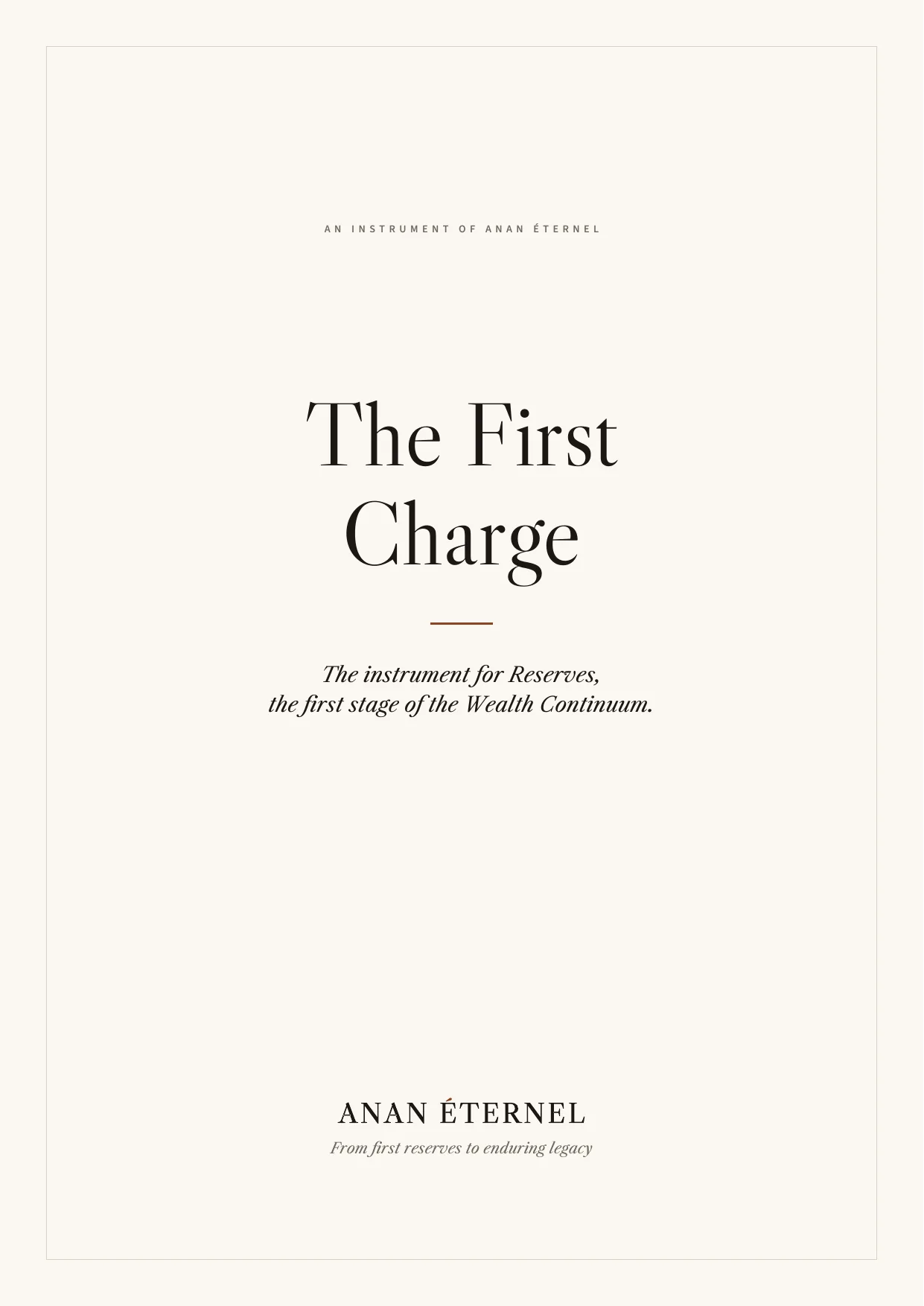
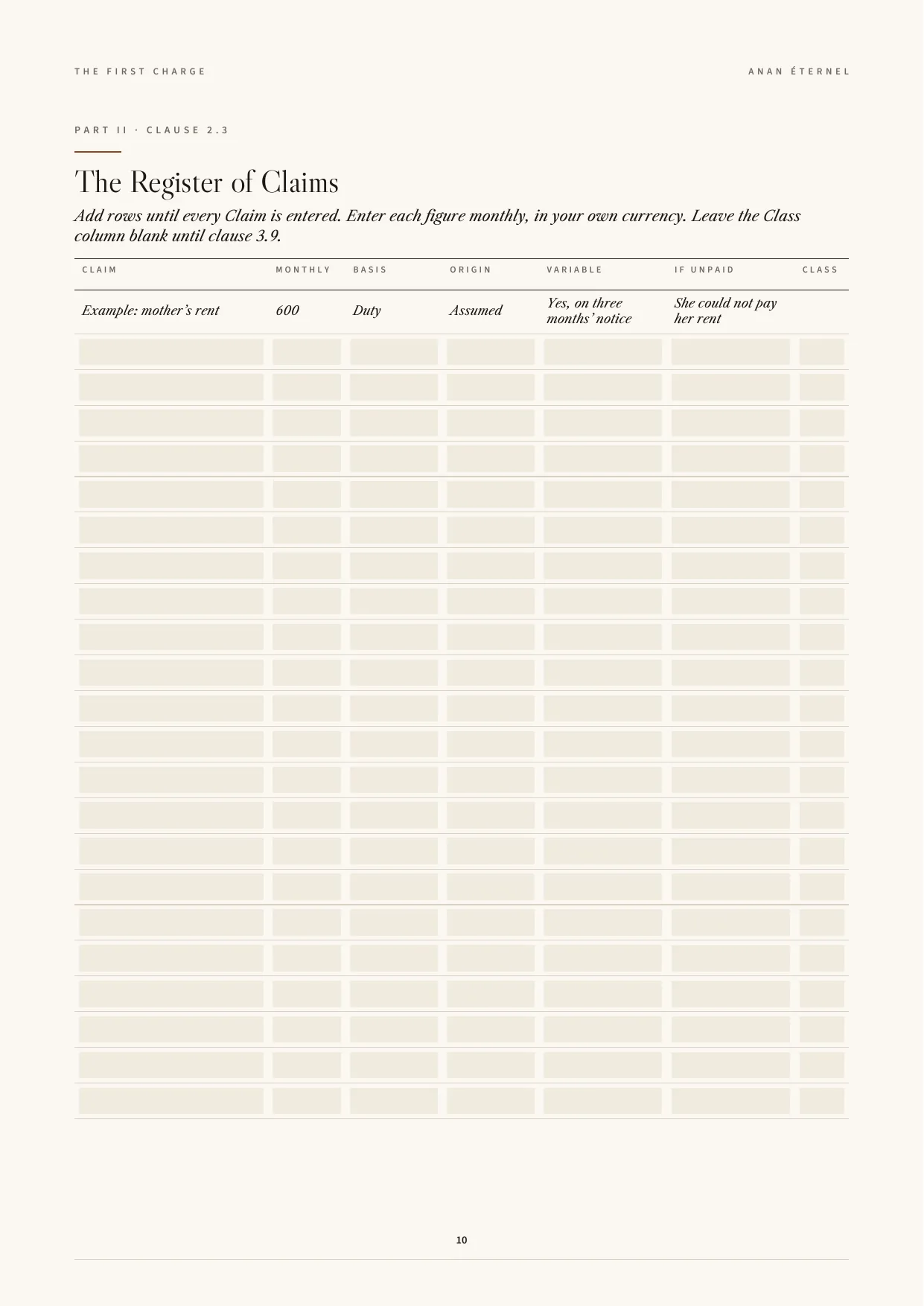
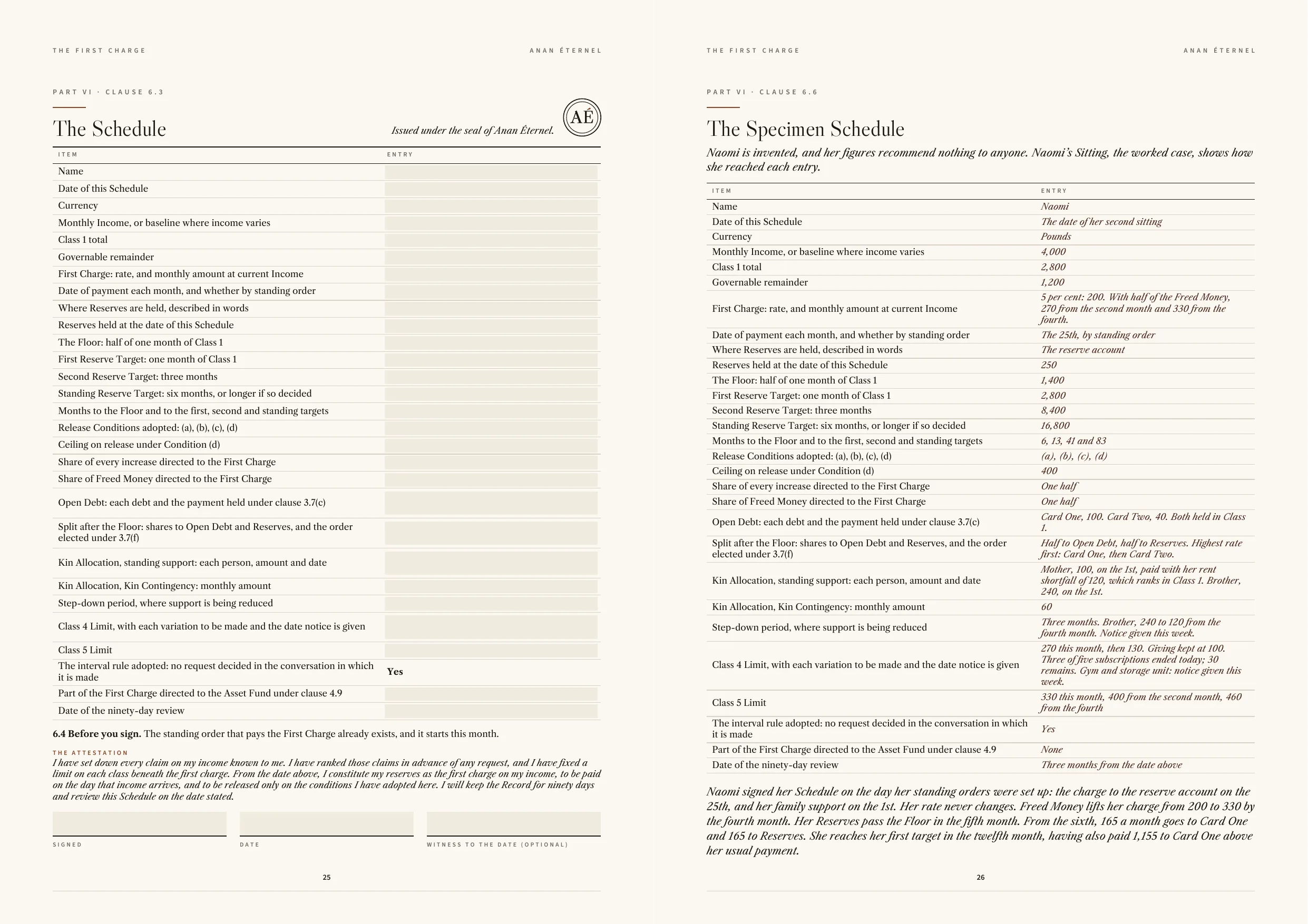
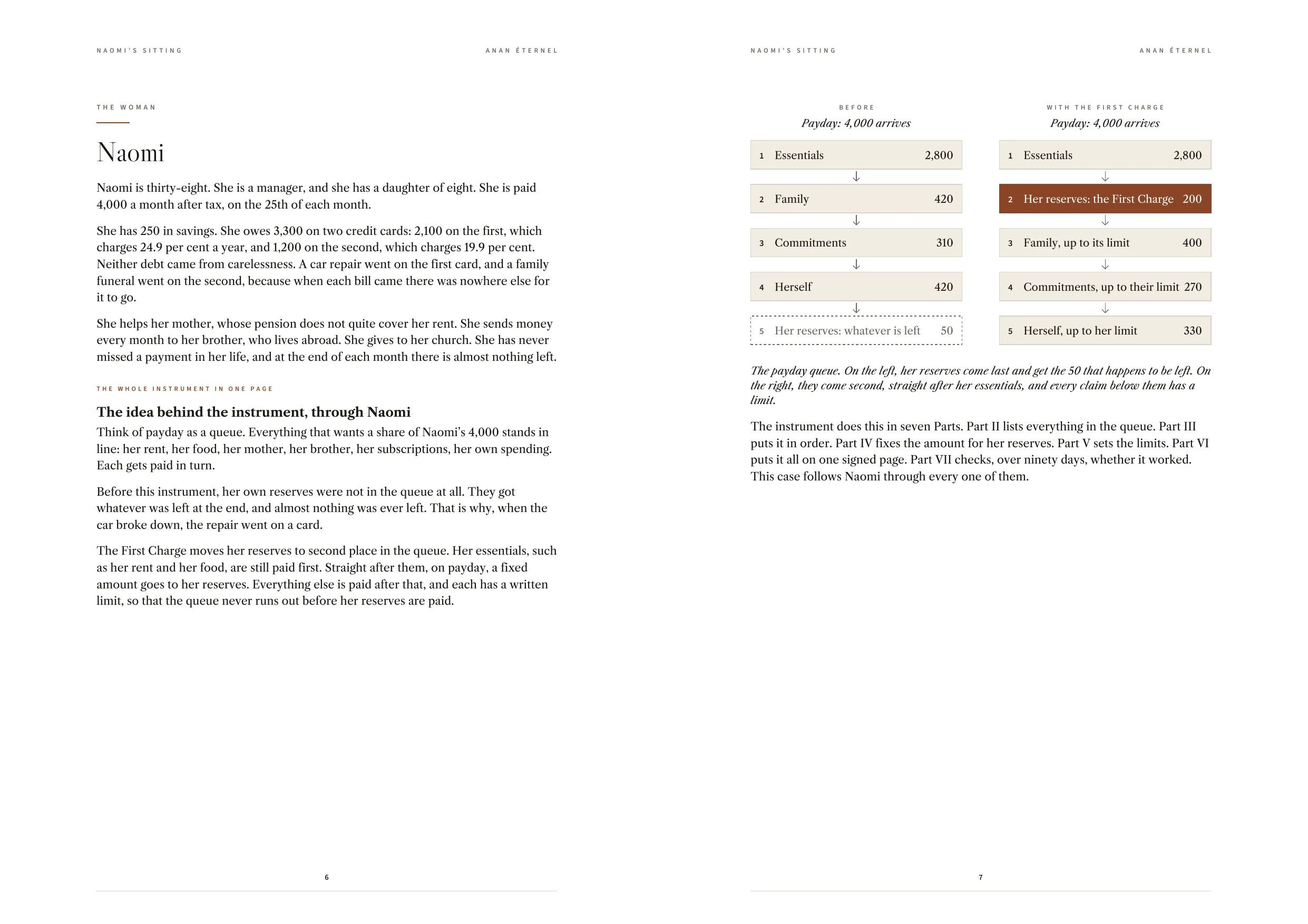
Four of the instrument's thirty pages, and two of the worked case.
What you receive
The First Charge
About thirty pages
The instrument itself. You set down every claim on your income, put it in order, fix your reserves and sign the page that runs it.
Naomi's Sitting, the complete worked case
Nearly fifty pages
One woman taken through every Part and every sum, with the reason for each entry, so you can see how it is done before you do it yourself.
Three letters from the author
At seven, thirty and ninety days
Sent by email, so you do not carry the work alone.
| Before you begin | First sitting | Second sitting | Then |
|---|---|---|---|
| 30 minutes Three months of statements, the people you support, your payday | 60 to 90 minutes The Register, your finding, the ranking | 45 to 60 minutes, within seven days The rate, the limits, the standing order, the signature | 5 minutes a month For ninety days |
Who it is for
For a woman whose income covers her life, and has never been put in written order.
The family's safety net
The one the family calls first, who says yes before the call has ended, and has nothing set aside for her own emergency.
Little or nothing left
A sound salary, no missed payment in years, and very little standing between the household and the next repair, or the next month without pay.
A card before the month is out
The income, properly ordered, would carry the household. Unordered, the shortfall goes on a card, quietly, at interest.
A surplus with no rule
Something is left each month, and it drifts, is spent, or sits with nothing written to protect it. Income at any level does not order itself.
If your income does not yet cover your essentials, this is not yet your instrument. Begin with Stabilisation Before Formation, which its author gives freely. Neither finding is a judgment on you. Each one tells you where the work begins.
The price
£120, paid once.
One payment for the instrument and the worked case. Delivered at once by email. Every three months you bring the figures up to date and sign a new Schedule from the same instrument, for as long as you use it: four Schedules in the first year, from one purchase.
If you change your mind before you download or open it, you may cancel within fourteen days for a full refund.
Payment is taken securely by Payhip, the house's checkout. Your files arrive by email.
A note from the founder
I watched women hold up whole households and still have very little ground that was securely theirs. Money came in and was committed elsewhere before it could settle, and every month the reserve was whatever was left. I wrote The First Charge so that a woman's reserves stop waiting their turn: decided once, in writing, and paid before anyone can ask. It is the first instrument of the house because everything that comes after rests on it.
Chidimma Ochiogu, author of The Sovereign Woman Doctrine
Questions
I've tried budgeting before
A budget asks you to decide again every month, and the month usually wins. The First Charge does not ask you to decide more often. It asks you to decide once: every claim on your income is written down and ranked, your reserves are fixed second, and a standing order pays them on payday before anything else can reach them. The method is not more discipline. It is order.
I'm afraid to look at my numbers
Most people are. Looking at a balance you suspect is low hurts, and on its own it changes nothing, so it is natural to put it off. The First Charge asks you to look properly twice, in two sittings, with three months of statements beside you. What you find is written into the Register and given its place, so the looking leads somewhere. After you sign, the standing order moves your reserves on payday without a decision from you, and one entry at the end of each month, about five minutes, records whether the order held.
I don't earn much
The First Charge is a percentage of your income, not a fixed sum. You choose the highest rate you would still pay in your worst ordinary month, and it can be small. A small rate that holds for ninety days does more than a large one that fails in the third week. It can be small, but it cannot be nothing. If your income does not yet cover your essentials, begin with Stabilisation Before Formation instead. It is free.
I'm not good with numbers
You do not need to be. Naomi's Sitting takes one woman through every Part and shows every sum written out, with the reason for each entry, so you can follow it line by line with your own figures beside it. The arithmetic is adding, multiplying and dividing. The instrument asks you to work out each total yourself and check it, and the worked case shows you how.
How do I say no to the next request without feeling guilty?
You do not decide in the conversation. The amount for family was set aside at the start of the month, so your answer is a fact, not a refusal: you look at what is there, and you reply the next day. Guilt is sharpest when a decision is made on the spot, with someone waiting. The instrument takes the decision out of that moment.
I support my family
Then the instrument was written with you in mind. The people you support keep their place: they are paid by standing order, a set amount on a set day, straight after your reserves. Where not paying would put someone's home, food, health or safety at risk within thirty days, that claim ranks with your own essentials, ahead of your reserves. The instrument also sets out how to answer a request above the limit, so that one request does not undo the order.
What will my family think?
They will know where they stand, perhaps for the first time. The instrument asks you to tell them before anything changes, at a calm time you choose and never in answer to a request, naming the amount and the day. If what you give has to come down, it comes down in steps, with notice, never suddenly. After that, they receive a set amount on a set day without having to ask. When someone asks for more, you never decide during the conversation: you wait a day, ask four written questions, and give your answer once you have.
Will my family know what I hold?
Those you support are told their amount and their date, because being able to rely on it is the benefit to them. Whether anyone knows your reserves exist, or what they hold, is yours alone to decide.
Can I pay in instalments?
No. Instalments on anything bought now and paid for later are one of the claims the Register asks you to find and rank. The house will not sell an instrument that adds a row to it.
What if something breaks in the first months?
You decide in advance, in writing, when your reserves may be used: if your income stops or falls sharply, if an essential bill cannot be paid any other way, if an emergency threatens your health, safety, home or ability to earn, or, up to a ceiling you fix calmly, a grave emergency in your family. If one happens, you use them, record it the same day, keep paying the charge, and raise no other limit until the reserves are rebuilt. In the first months your reserves will be small and may not cover a large bill on their own. They are still the first money that is yours to meet it with, and each month they grow.
Is this financial advice?
No. The First Charge is an educational instrument that you complete for yourself. It does not take account of your particular circumstances, it recommends no bank, account or product, and it does not tell you which debt to pay. Anan Eternel Ltd is not authorised or regulated by the Financial Conduct Authority. Where your situation involves debt, investment, tax or a legal dispute, take advice from a qualified professional. If you are behind on rent, tax, energy or similar bills, speak to a free debt adviser before anything else; in the UK, free and confidential help is available from MoneyHelper.
What format is it, and what do I need to open it?
The First Charge and Naomi's Sitting are PDF documents. They arrive by a download link in your confirmation email, which stays available for at least twelve months. They open on a phone, tablet or computer with any PDF reader, and you may print them for your own use. To fill in The First Charge, use Adobe Acrobat Reader, which is free: many phone and browser viewers show the fields but do not keep what you type. For the sittings you will also want three months of bank statements, and your banking app to set up the standing order. Every page of your copy carries your email address and the date you bought it, because it is licensed to you.
What if it isn't right for me?
You can see whether it is before you buy. Every part is described on this page, with pages from the instrument and the worked case, and the section above says plainly who it is for. If your income does not yet cover your essentials, it is not yet your instrument, and Stabilisation Before Formation is the place to begin. If you buy and change your mind before you download or open it, you may cancel within fourteen days for a full refund. Once downloaded, the instrument is yours to keep and use, and no refund is given for a change of mind. If a file is faulty or will not open, write to order@ananeternel.com and the house will put it right. The Terms of Sale set out the detail.
Who is behind it?
The First Charge is written by Chidimma Ochiogu, author of The Sovereign Woman Doctrine, and published by Anan Éternel, a House of Governance for women's wealth and ownership. The house is Anan Eternel Ltd, registered in England and Wales. The First Charge is its first instrument, for the first stage of its work: reserves.
Where reserves are absent, pressure governs. Where reserves exist, judgment gains room.
Law VII, Reserves Are Power · The Sovereign Woman Doctrine
£120, paid once
Payment is taken securely by Payhip, the house's checkout. Your files arrive by email.
Three doors
- Buy The First Charge
Payment is taken securely by Payhip, the house's checkout. Your files arrive by email.
The instrument. £120, paid once.
- See your own queue
A fifteen-minute worksheet with your own figures. Free.
- Start at the foundation
Stabilisation Before Formation: the ground to secure before any money is set aside. Free.